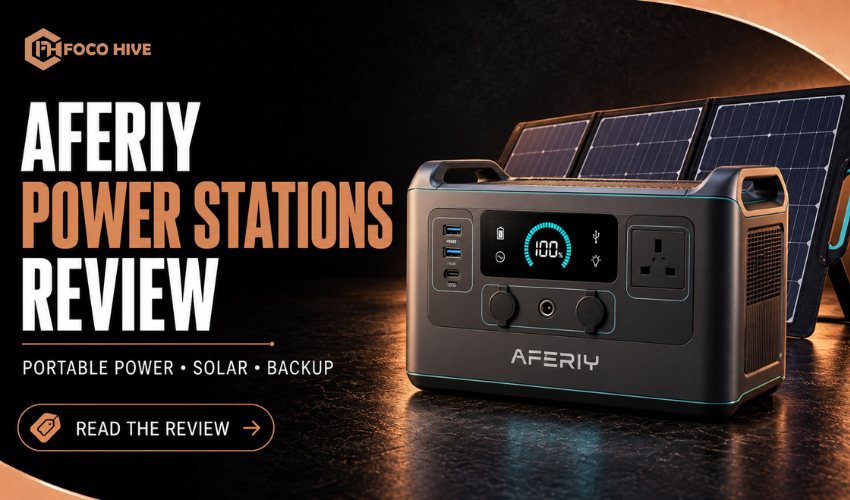
A portable power station can keep a few essentials running during a power cut or make a campsite much more comfortable, but the largest wattage on the box is rarely the whole story. Battery capacity, appliance demand, charging options and the effort of moving the unit all matter. This AFERIY review examines the UK range with those practical decisions in mind, focusing on the P210, P280, P310 and P180 Pro.
AFERIY’s appeal is a combination of substantial battery capacities, mains and solar charging, and prices that invite comparison with familiar alternatives. The difficulty is working out what you actually need. The P210 and P280 share the same base capacity despite different output ratings, while the smaller P180 Pro and larger P310 suit quite different carrying and runtime requirements.
This is a research-based assessment of official UK listings, comparison information, published support terms and selected seller-hosted feedback, checked on October 19, 2026. It does not claim personal discharge tests, measured fan noise or hands-on solar trials. Manufacturer specifications are identified as published claims, and the runtime example below is explicitly a calculation rather than a test result.
AFERIY at a Glance
Quick Verdict — Worth comparing when capacity, portability and support terms fit your needs
Best for: UK buyers planning campsite power, portable office use or backup for selected plug-in appliances.
Main strengths: Several capacity classes, published LiFePO₄ battery specifications and expansion options on selected models.
Main limitations: Significant weight on larger units, variable promotional pricing and strict published change-of-mind return conditions. Some solar-input information needs clarification before connecting panels.
Overall assessment: The range has credible features to investigate, but measured efficiency, noise and long-term reliability remain unverified here. No numerical performance rating is assigned.
Find the Right Size Before Choosing a Bundle
Compare battery capacity, continuous output and carrying weight, then check the exact UK kit and current price.
Explore AFERIY UK →What Is AFERIY?
AFERIY sells portable battery power stations, solar panels, expansion batteries and related charging accessories through its UK storefront. Current navigation uses Haven names alongside P-series model numbers, so Haven2400 and P210, for example, appear within the same product family. Matching the full model number helps avoid confusing a station-only listing with a panel bundle or an expansion battery.
A portable station stores electricity and supplies it through supported outputs. A “solar generator” bundle adds compatible solar equipment; it does not produce energy without a source of charging power. That distinction matters when planning an outage: buying a larger inverter does not create more stored energy, and buying a solar kit does not guarantee enough sunlight to replace everything you use.
Key Features and Product Range
AFERIY P210 review: the straightforward 2kWh option
The P210 UK listing specifies 2,048Wh capacity and 2,400W continuous pure-sine-wave AC output. It lists up to 1,100W AC charging and 500W solar input, while the brand’s comparison guide identifies the model as non-expandable. This makes it a sensible starting point for buyers who want a self-contained station rather than a growing battery system.
Its main buying limitation is that the capacity you choose is the capacity you keep. If your intended appliances fit the output limit and your energy budget is modest, expansion may be unnecessary. If longer outages or increased demand are likely, price the expandable alternatives before assuming the least expensive initial purchase will remain the best value.
AFERIY P280 review: more flexibility without more base energy
The P280 lists 2,800W continuous output and the same 2,048Wh base capacity. AFERIY states that compatible extra batteries can take total capacity to 10,240Wh. Its P210-versus-P280 comparison also lists higher AC and solar charging limits: 1,800W and 1,200W respectively. Those upgrades address appliance compatibility, recharging and future capacity rather than automatically extending the runtime of the unexpanded unit.
This is the important distinction for a buyer comparing the two. A higher-output inverter may run a more demanding appliance, but the same appliance still needs roughly the same amount of energy. Choose the P280 because its capabilities match your plan, not because the higher model number implies a larger battery out of the box. Additional batteries are separate purchases unless a selected bundle explicitly includes them.
AFERIY P310 review: a larger reserve with a carrying tradeoff
The P310 listing specifies 3,840Wh base capacity, 3,600W AC output and expansion up to 11,520Wh. It also lists a 40kg weight and shows wheels with a retractable handle. That places it in a different practical category from a small camping battery, even though the product remains transportable.
Wheels can help on a suitable surface, but they do not remove the problem of lifting a unit into a car or moving it upstairs. Think through where it will live and how often it must move before paying for additional capacity. A larger reserve can be valuable for selected household essentials, yet it may be unnecessary bulk for someone mainly charging phones, cameras and a laptop.
AFERIY P180 Pro review: the more manageable starting point
The Nomad1800 Pro, also labelled P180 Pro lists 1,024Wh base capacity, 1,800W output and expansion up to 5,120Wh. Its specifications give a weight of 11.64kg. This is the more plausible starting point when regular lifting matters, although it still deserves a realistic carrying assessment rather than being treated like a pocket-sized power bank.
The compromise is a smaller initial energy reserve. It may suit lighter use particularly well, but a large output figure does not make a small battery last indefinitely with high-demand appliances. Compare the complete expanded configuration if you already expect to need extra capacity; the light base unit and a multi-battery arrangement are different ownership propositions.
| Model | Published base capacity | Continuous AC output | Published expansion ceiling |
| P180 Pro / Nomad1800 Pro | 1,024Wh | 1,800W | 5,120Wh with compatible extras |
| P210 / Haven2400 | 2,048Wh | 2,400W | Not expandable in the checked guide |
| P280 / Haven2800 | 2,048Wh | 2,800W | 10,240Wh with compatible extras |
| P310 / Haven3600 | 3,840Wh | 3,600W | 11,520Wh with compatible extras |
First Impressions and Design: What the Listings Show
Product photographs show front-facing displays and grouped controls, with different socket and carrying arrangements across the range. The P310’s trolley-style approach is visibly different from the smaller units’ carrying designs. These are useful observations about layout, but they do not establish switch quality, display readability outdoors or resistance to knocks. Those details need physical inspection or well-documented testing.
Before ordering, map the station onto its intended location. Allow room for plugs, cables and the ventilation clearances required by the manual, rather than measuring only the case. In a vehicle, also consider secure transport and convenient access after unloading. A neatly photographed product can become awkward if its sockets face a wall or its handles are difficult to reach in your storage space.
Performance and Practical Use
Watts and watt-hours answer different questions
Watts describe power demand at a particular moment; watt-hours describe stored energy. A 100W load running for ten hours uses 1,000Wh before accounting for conversion and system losses. A station therefore needs both enough output to run an appliance and enough usable energy to run it for the desired duration. Neither specification can replace the other.
An illustrative calculation makes the difference clearer. Assuming 85% of a 2,048Wh battery became usable AC energy, a constant 100W load would run for about 17.4 hours: 2,048 × 0.85 ÷ 100. The 85% figure is an assumption for explanation, not measured AFERIY efficiency. Real runtime depends on load, inverter overhead, temperature, battery condition and operating settings.
For appliances that cycle, such as refrigeration, instantaneous wattage is particularly easy to misread. A compressor’s running demand, start-up surge and daily energy consumption answer different planning questions. Measure the appliance over a representative period where possible, and check compatibility against the actual model’s specifications. Do not convert a generic appliance icon into a guaranteed number of hours.
High output is useful, but heating drains energy quickly
Electric heating illustrates why output and endurance must be considered together. A hypothetical 2,000W heater consumes 2,000Wh in one hour of continuous operation. Even a station able to supply that power may offer only a short period of heating once losses are included. The calculation is about energy demand, not a measured runtime claim for a particular AFERIY unit.
Charging speed: separate maximum input from a normal session
AFERIY publishes different charging limits for different models, and some pages advertise especially short recharge times using combined AC and solar input. Those figures require the stated conditions and sufficient available input. A maximum charging rate is not a promise that the battery accepts that rate continuously from empty to full, nor that a smaller panel bundle will deliver it.
For practical planning, consider the charging source you genuinely have. A short stop with a mains socket differs from a full day parked in sunshine, while a low-power vehicle connection may be much slower. Compare the selected model’s manual and charging setup rather than buying around the fastest number anywhere on the website. Adjustable input can also matter when sharing a supply with other equipment.
Solar generator review: panel compatibility comes first
An AFERIY solar generator review needs to examine the station, panels and connecting equipment as a system. The P210 information illustrates why: its product FAQ mentions a 48V maximum, while the comparison guide gives an input range reaching 50V. That discrepancy should be clarified against the supplied manual and with AFERIY before choosing a third-party array; this article does not resolve it by selecting the more permissive figure.
Panel wattage alone is insufficient. Confirm the permitted voltage and current, connector arrangement and approved configuration, including voltage changes in cold conditions. A matching connector does not prove electrical compatibility. Likewise, a panel’s weather-resistance claim should not be transferred to the station, cables or sockets. Follow the instructions for every component and keep the station in its specified operating environment.
For UK travel, treat solar generation as weather-dependent replenishment rather than an assured daily allowance. Orientation, shade, available daylight and the time you can leave panels deployed all affect usefulness. Size the battery around the energy you need to store, then assess whether the chosen panels and your expected conditions provide a realistic route to recharging it.
UPS features, noise and battery-life claims
Several checked listings advertise roughly 10ms switching for backup use. This is a manufacturer specification, not a guarantee that every connected device will remain uninterrupted. Confirm compatibility and behaviour before relying on it for a server or other important equipment. A portable unit should power suitable plug-in loads as instructed; connecting it into fixed building wiring requires an appropriate professionally designed arrangement, never backfeeding through a wall socket.
Fan noise and idle consumption can matter as much as headline output for overnight or office use, but neither was measured in this review. Similarly, a stated cycle count is a manufacturer claim under specified conditions, not proof of an exact service life. Battery aging and coverage terms should be considered separately; an advertised durability figure is not automatically a promise of free replacement for ordinary capacity loss.
Pricing and Value for Money
The table below uses the station-only prices displayed on the checked UK product pages. They are GBP snapshots, with the listings displaying VAT-inclusive pricing, rather than a promise of future availability or a verified saving against crossed-out prices. Older campaign pages showed different amounts, so use the selected product and checkout to confirm your actual order.
| Station | Displayed base price | Value consideration |
| P180 Pro | £459 | Lower entry cost and smaller base reserve |
| P210 | £699 | 2,048Wh without expansion |
| P280 | £829 | Same base capacity; extra output and expansion support |
| P310 | £1,359 | Larger base reserve, higher output and greater weight |
At those listed prices, the P280 costs £130 more than the P210. That premium needs to earn its place through expansion, charging capability or appliance requirements, because it does not buy more base watt-hours. Compare battery-only and solar bundles carefully: panels, extension cables and extra batteries can make the final system price quite different from the station headline.
The warranty policy describes two years of base coverage plus a five-year extension for eligible stations rated at least 400W, requiring product registration. Its shipping table says customers bear shipping both ways for eligible repair support after two years. Keep proof of purchase and confirm registration requirements rather than interpreting “up to seven years” as seven years of identical service conditions.
The published return policy is also important: its change-of-mind route specifies 30 days from purchase and unopened, unused goods in original condition, with shipping and payment-related deductions described. This is not presented as a free hands-on trial. Confirm current terms before ordering, especially for a heavy unit; the retailer’s policy summary is not an assessment of all consumer rights.
Compare the Complete System Cost
Check the exact station, expansion batteries, panel configuration and support conditions before choosing a promotional bundle.
Check Current AFERIY UK Options →AFERIY Pros and Cons
| Advantages | Limitations |
| A useful spread of battery capacities and outputs | Large model numbers can obscure identical base capacity |
| Expansion available on selected models | P210 is not expandable in the checked guide |
| Mains and solar charging options | Real solar performance depends on the complete setup |
| P180 Pro offers a lighter alternative to larger units | P310 is listed at 40kg despite its wheels |
| Published extended-warranty route for eligible stations | Registration and changing shipping responsibilities matter |
| Detailed specifications available online | Some figures differ between pages and need clarification |
| Competitive-looking station prices to investigate | Strict published change-of-mind conditions and deductions |
Who Should Buy AFERIY?
AFERIY is worth considering if you can describe the devices you need to power and calculate an approximate energy budget. The range gives buyers several ways to balance carrying effort against stored energy. It is particularly relevant when you want portable power for selected tasks rather than expecting one purchase to replace a permanently installed household system.
| Your priority | Starting point | What to confirm |
| Regular lifting and lighter electrical needs | P180 Pro | Base capacity and appliance demand |
| A self-contained 2kWh purchase | P210 | No requirement for later expansion |
| More output and future capacity options | P280 | Expansion cost and charging plan |
| A larger reserve kept mainly in one location | P310 | Lifting, storage and total system size |
Who Should Consider Another Option?
Consider a smaller product if your main task is charging a phone on the move, or a more permanent system if your goal is extensive household backup. A large transportable battery can be an awkward compromise when both carrying and long-duration high-power use are priorities. Buy around your most important requirement rather than trying to cover every hypothetical scenario.
Customer Feedback and Common Concerns
The checked seller-hosted P180 Pro comments include positive accounts of weekend use and appreciation of lower carrying weight compared with the P310. Those are individual reports rather than independently verified runtime tests. Their usefulness depends on the actual equipment used, charging conditions and duration, which cannot be assumed to match another buyer’s trip.
Model attribution also deserves care. A visible comment on the P280 page explicitly discusses a P210 purchase, showing that a product-page review collection may contain feedback about another model. When reading AFERIY reviews, check the unit named in the comment instead of assuming every star or story applies directly to the listing above it.
Competitor Comparison: AFERIY, EcoFlow and BLUETTI
The EcoFlow DELTA 2 Max and BLUETTI AC200L are relevant 2,048Wh alternatives. Their official listings identify 2,400W AC output and expansion options, making them useful comparisons with the P210 and P280. That establishes a comparable specification class, not equivalent efficiency, build quality or service. Current rival prices are deliberately omitted because configurations and promotions differ.
| Model | Published base capacity | Published continuous AC output | Comparison focus |
| AFERIY P210 | 2,048Wh | 2,400W | Self-contained cost; no expansion |
| AFERIY P280 | 2,048Wh | 2,800W | Expansion plan and recharge limits |
| EcoFlow DELTA 2 Max | 2,048Wh | 2,400W | Compatible batteries, accessories and support terms |
| BLUETTI AC200L | 2,048Wh | 2,400W | Expansion compatibility and complete delivered cost |
Ask the same questions of each: what is included, which battery is compatible, how much can you realistically lift, and what happens if service is needed? Compare ordinary continuous output with ordinary continuous output rather than mixing surge or special power modes into the ranking. Without matched discharge and load tests, a feature table cannot establish a performance winner.
Frequently Asked Questions
Is AFERIY worth buying?
AFERIY is worth comparing when the selected model fits your appliance demand, energy budget and carrying needs. Check the complete price, published return conditions and warranty registration requirements. This review supports a considered shortlist, not a guarantee of measured efficiency or long-term reliability.
What is the difference between the P210 and P280?
Both list 2,048Wh base capacity. The P280 offers higher continuous output, higher published charging limits and battery expansion, while the checked comparison guide identifies the P210 as non-expandable. A higher output rating does not automatically extend runtime with the same load.
Is the P180 Pro the same as Nomad1800 Pro?
The checked UK listing identifies Nomad1800 Pro as P180 Pro. It lists 1,024Wh base capacity and 1,800W output, with expansion available through compatible extra batteries. Confirm the full model and selected bundle because the non-Pro P180 is a separate listing.
How portable is the AFERIY P310?
The official specifications list 40kg and show wheels with a retractable handle. That may help movement on suitable ground, but loading a vehicle or navigating stairs remains a substantial consideration. Assess the actual route and lifting requirements before buying.
How long will an AFERIY power station run a fridge?
There is no dependable universal runtime. Compressor cycling, start-up demand, temperature and actual daily energy consumption affect the answer. Measure your appliance and account for conversion losses; do not treat a generic fridge illustration or another customer’s trip as a test of your setup.
Can an AFERIY station run a kettle or heater?
Only if the appliance’s requirements fit the selected station’s continuous output and other operating limits. High-demand heating also uses stored energy quickly. Check the appliance label and station manual rather than assuming that a large battery or surge figure guarantees compatibility.
Can I use third-party solar panels?
Compatibility depends on the exact station’s permitted voltage, current, power and connection arrangement. Published P210 voltage figures differ between pages, so resolve that discrepancy against the supplied manual and with AFERIY before connecting an array. A matching connector or panel wattage alone is insufficient.
Does the UPS feature guarantee uninterrupted operation?
No. The advertised switching time does not guarantee compatibility with every connected device. Confirm behaviour with the intended equipment and follow the manual. Specialist or critical backup requirements need a suitable equipment-specific plan rather than reliance on a general product description.
How long is the AFERIY UK warranty?
The checked policy provides a two-year base plus a five-year registered extension for eligible stations rated at least 400W. Conditions apply, and its table assigns shipping both ways to the customer for eligible repair support after two years. Confirm the current policy for your purchase.
Does AFERIY offer a 30-day trial?
The published policy describes a 30-day change-of-mind return route with unopened, unused goods and specified deductions. It should not be interpreted as an unrestricted free trial after using the station. Read current terms and obtain clarification before ordering if return flexibility is important.
Final Verdict: Is AFERIY Worth Your Money?
AFERIY offers a useful range of portable-power configurations, with clear reasons to investigate each model. The P180 Pro is the carrying-conscious option, the P210 provides a fixed 2kWh-class reserve, the P280 adds flexibility, and the P310 moves toward larger stored energy with a substantial weight penalty. None is automatically the best choice for every buyer.
The strongest purchase starts with an energy budget and ends with checking the exact manual, bundle and after-sales terms. Pricing may be attractive, but unresolved specifications and restrictive return wording deserve attention before payment. If the chosen station meets your real requirements and those conditions are acceptable, AFERIY is a reasonable UK option to compare against established alternatives.
Choose the Capacity Your Plan Actually Needs
Make a short appliance list, estimate daily energy use and compare the right UK model before adding panels or expansion batteries.
Browse AFERIY Power Stations →